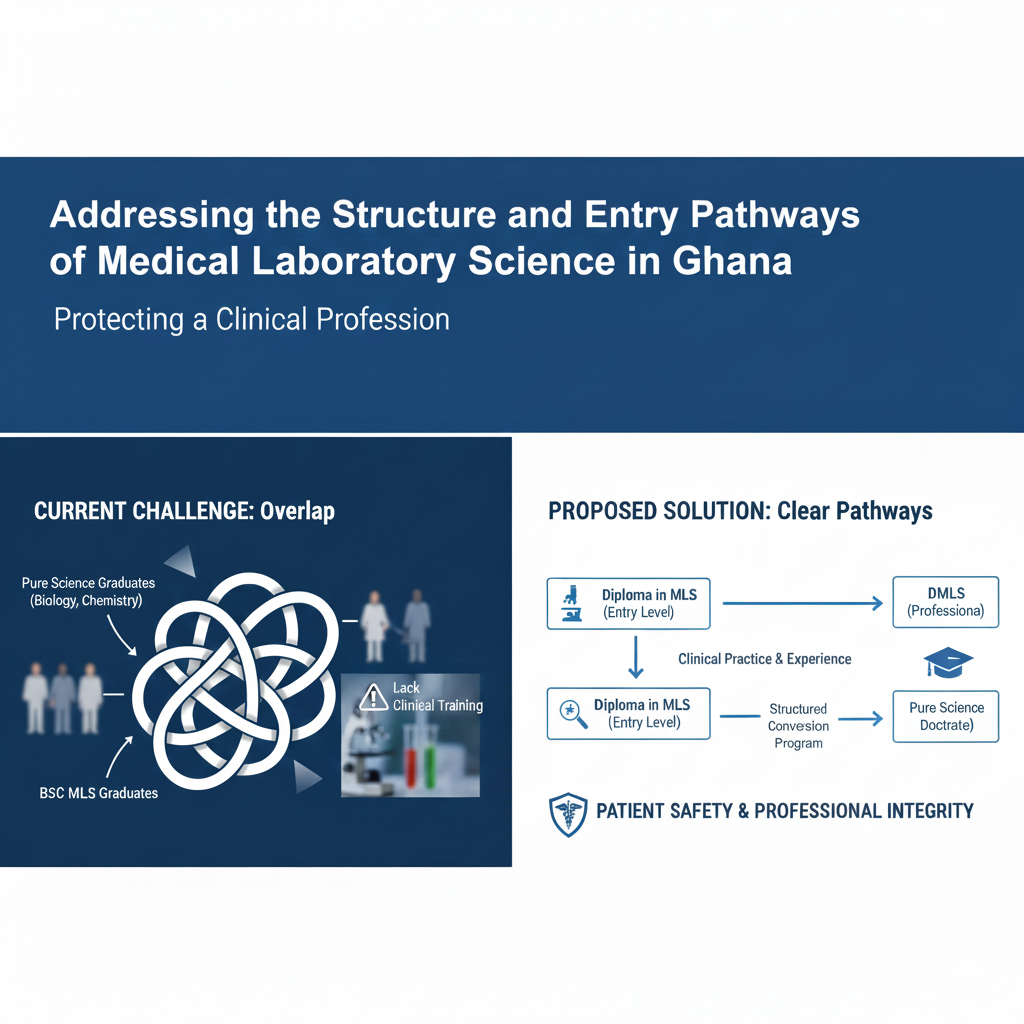
Medical Laboratory Science (MLS) in Ghana is currently structured into three main professional cadres: Diploma, Bachelor of Science (BSc), and Professional Doctorate (Doctor of Medical Laboratory Science – DMLS). This structure was established to ensure progressive training, professional competence, and patient safety within the healthcare system.
However, a growing concern within the profession is the entry and practice of individuals with pure science backgrounds—such as Biology, Chemistry, Biochemistry, Microbiology, Physics, and related disciplines—within hospital laboratories. While these disciplines provide strong theoretical foundations, they do not include structured clinical training in diagnosis, laboratory medicine, or patient-centred laboratory practice, which are core competencies required for safe and effective hospital laboratory work.

Laboratory diagnosis directly influences patient management, treatment decisions, and public health outcomes. Therefore, practitioners must be trained specifically in clinical diagnostics, quality assurance, laboratory ethics, biosafety, and hospital-based laboratory operations, which are not adequately covered in pure science degree programmes.
Medical Laboratory Science is a clinical profession, not a purely academic or experimental science.
In light of this, the continued existence of the BSc in Medical Laboratory Science as a parallel entry route has created professional overlap and encroachment, undermining the integrity of the profession. It allows individuals without sufficient diagnostic training to compete directly with clinically trained laboratory professionals within hospital settings.
To protect professional standards and improve healthcare delivery, it is proposed that:
- The BSc in Medical Laboratory Science be phased out or restructured, so that it no longer serves as a direct entry point into hospital laboratory practice.
- Only holders of accredited Diploma in Medical Laboratory Science should be permitted to practice at the operational level within hospital laboratories, as this cadre is specifically trained for hands-on diagnostic work.
- Individuals with pure science backgrounds who wish to transition into Medical Laboratory Science should:
a. Enter at Diploma level (thus if GAMLS and AHPC will consider absorbing them), regardless of prior academic qualifications.
b. Begin at academic Level 200, recognizing their foundational science knowledge while ensuring acquisition of essential clinical laboratory competencies.
- Progression to the Doctor of Medical Laboratory Science (DMLS) should follow a clearly defined professional pathway based on clinical competence, structured training, and regulatory approval.
This approach will:
- Eliminate professional encroachment into hospital laboratories.
- Ensure all practicing laboratory professionals possess adequate diagnostic training.
- Strengthen patient safety and quality of laboratory services.
- Promote a clear, competency-based career progression within Medical Laboratory Science in Ghana.
In conclusion, Medical Laboratory Science must be protected and recognized as a distinct clinical profession. Aligning entry routes with clinical competence rather than purely academic qualifications is essential for the credibility, sustainability, and advancement of the profession in Ghana.
Dr. Ishmael Klu Adjei, MLS.D
(AKI-STONE)