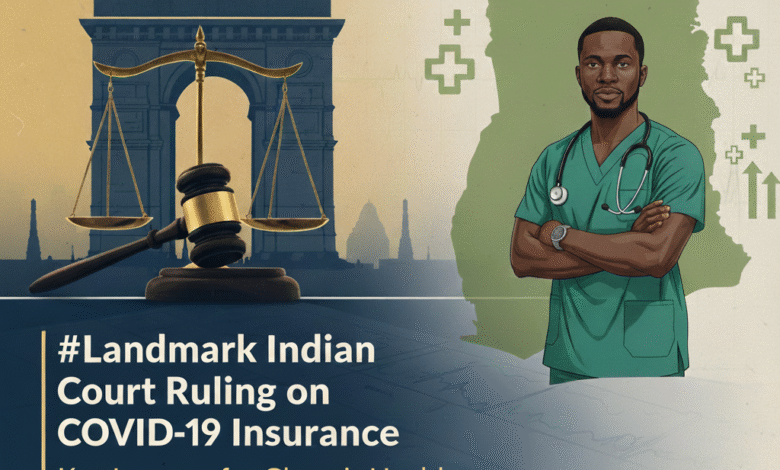
Landmark Indian Court Ruling on COVID-19 Insurance: Key Lessons for Ghana’s Healthcare

By Dr. Evans Kyeremeh
December 12, 2025
In a significant ruling with potential global implications, India’s Supreme Court has today declared that the families of private doctors and medical professionals who died while performing COVID-19 duties are entitled to a state-backed insurance benefit, overturning previous denials. This judgment reinforces a critical principle: during a national health crisis, all frontline health workers who step forward share the same risks and deserve the same security.
🏛️ The Core of the Judgment
The court was reviewing the “Pradhan Mantri Garib Kalyan Yojna,” an insurance package launched in March 2020 to provide ₹5 million (approximately GHS 550,000) to families of frontline health workers who died of COVID-19. Insurers had denied claims for private doctors, arguing the scheme covered only those formally “requisitioned” by the government.
The Supreme Court bench, comprising Justices P.S. Narasimha and R. Mahadevan, rejected this narrow interpretation. In a powerful statement, the judges concluded that the “invocation of laws and regulations were intended to leave no stone unturned in requisitioning the doctors, and the insurance scheme was equally intended to assure doctors… that the country is with them.”
The court ruled that in the compelling circumstances of the pandemic, executive actions and laws effectively requisitioned all available medical personnel. Therefore, a lack of a formal government letter cannot be grounds for denial.
⚖️ The Burden of Proof
The judgment provides crucial clarity for claimants but also sets a clear evidentiary standard:
- The onus is on the claimant to prove the deceased lost their life while performing a COVID-19-related duty.
- This must be established with credible evidence.
- The key question is whether the professional “presented and offered his or her services in furtherance of Covid-19-related responsibilities.”
- Where such evidence is clear, “the policy will have to be applied.”
Parallels and Lessons for Ghana’s Health Sector
This Indian ruling resonates deeply with Ghana’s own experience during the pandemic. Ghana acted early to institute insurance coverage for frontline workers, but the journey highlights universal challenges:
- Ghana’s Response: In 2020, the Ghanaian government, through the COVID-19 Alleviation Programme, established a Frontline Health Workers’ Insurance Package. This aimed to provide financial security and motivate health workers.
- Similar Challenges: Like in the initial Indian denials, debates arose over the definition of “frontline,” coverage for private and quasi-government facility staff, and the documentation required to prove COVID-19 infection was duty-related.
- A Universal Principle: The Indian Supreme Court’s ruling underscores a vital, universal ethical and policy position: during a pandemic of this scale, the spirit of the law—to protect those who protect us—must prevail over rigid technicalities. It acknowledges the reality that in a crisis, service is often rendered out of duty before any formal appointment is processed.
💡 A Call for Clarity and Solidarity
For medical associations, insurance providers, and policymakers in Ghana and across Africa, this ruling is a instructive precedent. It advocates for:
- Broad, Inclusive Definitions in emergency insurance policies.
- Clear, Accessible Guidelines on the evidence required for a claim.
- A Pro-Citizen Interpretation of laws during national emergencies.
The judgment closes with a reaffirmation of the social contract: “The insurance scheme was… intended to assure doctors and health professionals on the front line that the country is with them.” As we reflect on the sacrifices made during the pandemic, this principle of solidarity is one every nation must strive to uphold for its health heroes.
Disclaimer: This article is for informational purposes based on a reported court ruling in India and general knowledge of Ghana’s pandemic response. It does not constitute legal advice. Health professionals with specific insurance concerns should consult relevant authorities or legal experts.
Discover more from MedCircles Ghana
Subscribe to get the latest posts sent to your email.